
My Puppy Development Program
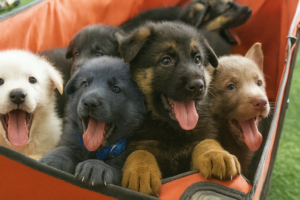
🐾 My Puppy Development Program
Raising a confident, well-adjusted German Shepherd puppy begins long before the day they go home. At Purple Pups GSD, my puppy development program makes intentional use of the time from birth until my puppies are ready to go home at 60 days or older, helping each puppy build a strong foundation for life.
From the very beginning, I introduce experiences that are appropriate for each stage of development. We start with gentle handling and Early Neurological Stimulation (ENS), then gradually add new sounds, textures, surfaces, objects, toys, people, grooming experiences, car rides, crate conditioning, early house-training routines, and more as the puppies grow.
But my goal isn’t simply to expose puppies to as many things as possible. It’s how those experiences are introduced that matters.
I give my puppies opportunities to explore, investigate, and work through new experiences at their own pace. I don’t expect every puppy to react the same way, and I don’t force a hesitant puppy into an interaction. Instead, I watch how each puppy responds – whether they approach immediately, stop and observe, investigate cautiously, or need a little more time to become comfortable.
These everyday experiences help me learn more about each puppy as an individual while giving them opportunities to build confidence, curiosity, and resilience. As they grow, those observations also become part of the bigger picture I use when evaluating temperament and eventually matching each puppy with a family whose lifestyle and needs are well suited to that puppy.
💜 The goal isn’t to prepare every puppy for the same life. It’s to give each puppy a strong foundation for the life waiting for them.
🍼 Birth–16 Days: Warmth, Handling & ENS
During the first couple of weeks, puppies may seem to do little more than eat and sleep, but an incredible amount of development is already taking place. Their eyes and ears are still closed at birth, and they depend completely on their mother and me for warmth, nutrition, and care.
💜 Gentle Handling From the Beginning
From birth, each puppy is handled individually every day. These short, gentle interactions give me an opportunity to check each puppy from nose to tail while also introducing them to the sensation of being held and touched by a person.
I pay attention to how each puppy is nursing, moving, growing, and responding to handling. Because I spend time with them individually from the beginning, I can quickly notice if something seems different or a puppy needs a little extra attention.
⚖️ Monitoring Growth
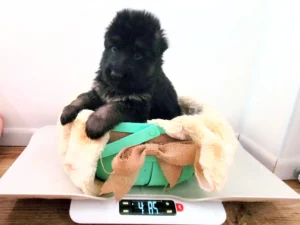
During the critical newborn period, I weigh each puppy daily to make sure everyone is gaining appropriately. Weight is one of the simplest ways to identify a potential problem early, especially before a puppy is old enough to show more obvious signs that something may be wrong.
Once the puppies are consistently thriving and gaining well, I transition from daily weighing to weekly weigh-ins so I can continue following their growth throughout the rest of their time with me. These weekly checks also give me another opportunity to observe each puppy individually as they grow and develop.
🧠 Early Neurological Stimulation
Beginning at 3 days old and continuing through day 16, I perform Early Neurological Stimulation (ENS) with each puppy once a day.
ENS consists of five brief exercises that introduce a puppy to mild, controlled forms of stimulation during a specific period of early neurological development. Each session takes only a short amount of time and is done gently and individually.
ENS is just one small part of my overall puppy development program. It doesn’t replace good genetics, proper care, socialization, or the many experiences that come later. Instead, it is one of the first age-appropriate experiences I provide as the puppies begin their journey from completely dependent newborns to curious young German Shepherds.
Want to see exactly what I do? Visit my Early Neurological Stimulation (ENS) for German Shepherd Puppies page for a closer look at the five exercises and why I include them in my program.
🐾 First Steps at Just 16 Days Old
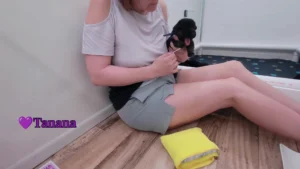
Development doesn’t happen according to an exact calendar. At just 16 days old, one of my puppies was already beginning to take those wonderfully wobbly first steps – a perfect glimpse of the transition from the newborn stage into a whole new world of movement and exploration.
👀 17 Days–4 Weeks: The First Steps Into Exploration
Those observations continue throughout the following weeks and, along with formal temperament testing later in the program, help me develop a much fuller picture of each puppy as an individual.
🐾 Learning to Move & Explore
Around the third week of life, the puppies begin changing almost daily. Their eyes and ears are opening, their legs are becoming stronger, and they are starting to notice and interact with the world around them.
This is an exciting transition from the quiet newborn stage into a period of growing curiosity and exploration.
At first, walking is a wonderfully wobbly process. As the puppies gain strength and coordination, I give them safe opportunities to move around, explore their environment, and learn what their growing bodies can do.
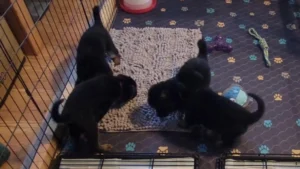
Their world gradually becomes a little bigger and more interesting. I begin introducing age-appropriate experiences such as:
*Different textures beneath their feet
*Soft toys and safe objects to investigate
*Gentle household sounds
*Changes within their familiar environment
Short periods of individual handling and attention
Everything is introduced gradually and with their developmental stage in mind. At this age, more isn’t necessarily better. The goal is to provide small, positive opportunities to explore without overwhelming them.
🧸 Play Becomes an Important Teacher
This is also when the puppies begin interacting much more intentionally with their littermates.
Those early games of wrestling, mouthing, climbing over one another, chasing, and investigating toys may look like simple puppy play, but they are also opportunities to practice communication, coordination, and social interaction.
Their mother continues to play an important role as well. As the puppies become more active and independent, their interactions with Mom and their littermates provide experiences that people simply can’t duplicate.
💜 Watching Individual Personalities Emerge
One of my favorite parts of this stage is beginning to see little differences between the puppies.
Some may be the first to investigate something new. Another may prefer to watch for a moment before joining in. Some are especially interested in people, while others seem determined to explore every corner they can reach.
I don’t use these early behaviors to label a puppy’s temperament – there is still a tremendous amount of development ahead. Instead, I simply observe.
🌎 4–6 Weeks: Social, Emotional & Environmental Growth
Between four and six weeks, the puppies’ world gets much bigger. They’re more coordinated, increasingly curious, and ready for a greater variety of age-appropriate experiences.
This is when I begin expanding their environment and introducing new sights, sounds, textures, surfaces, objects, and simple challenges. Rather than introducing something new just for the sake of checking it off a list, I choose experiences that give the puppies opportunities to explore, think, adapt, and build confidence.
🐾 New Experiences, One Step at a Time
Throughout this stage, I introduce a variety of safe and age-appropriate experiences. These may include:
*Smooth, soft, firm, textured, noisy, or slightly unstable surfaces
*Different types of toys and unfamiliar objects
*Objects they can walk around, over, under, or through
*Safe opportunities for climbing and navigating simple obstacles
*Everyday household sights and sounds
*New areas of my home and, when appropriate, safe outdoor spaces
*Individual interaction and handling away from the litter
*Age-appropriate problem-solving opportunities
The specific activities may change from litter to litter, but the purpose remains the same: give each puppy opportunities to experience something unfamiliar and discover that they can successfully work through it.
💜 Building Confidence Without Forcing It
I don’t expect every puppy to immediately investigate every new experience – and I don’t force them to.
When something unfamiliar is introduced, one puppy may rush over to investigate while another stops to watch. A puppy may sniff cautiously, back away for a moment, approach from another direction, or simply need more time.
Those differences are valuable.
I give the puppies an opportunity to investigate at their own pace while I observe how they respond. The goal isn’t to prevent a puppy from ever feeling uncertain. Instead, I want to give them safe, age-appropriate opportunities to encounter something unfamiliar, process it, and discover that it isn’t something they need to fear.
Watching how each puppy approaches these experiences also helps me continue learning about them as individuals.
🏠 Early Foundations for Life With a Family
Environmental enrichment is only one part of this stage. Between four and six weeks, I also begin introducing more of the everyday routines the puppies will eventually encounter in their new homes.
Depending on their age and readiness, this includes:
*Beginning potty-area habits and early house-training foundations
*Early crate exposure and conditioning
*Wearing a collar
*Gentle grooming and nail care
*Increasing individual attention away from littermates
*Continued handling of paws, ears, mouth, and body
*Gradually experiencing more normal household activity
None of these skills is expected to be “finished” at this age. My goal is to give the puppies a positive introduction and a foundation their families can continue building upon after they go home.
🧠 Learning Through Everyday Experiences
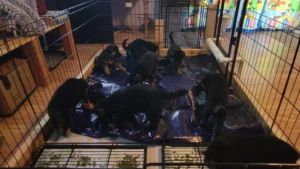
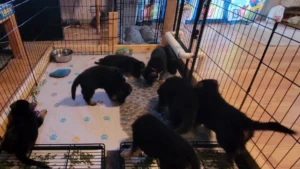
Some of the most valuable developmental activities don’t look like formal training at all. A crinkly tarp under their feet, an unusual bath mat, a new object, a different sound, or a simple obstacle to navigate can become a learning opportunity.
I watch what happens without immediately stepping in to solve everything for them. I give the puppies time to investigate, experiment, and figure things out for themselves whenever it is safe to do so.
These everyday experiences give the puppies opportunities to explore, think, adapt, and build confidence. At the same time, they give me another opportunity to observe how each puppy approaches something unfamiliar and continue learning about each puppy as an individual.
📸 Puppy Development in Action
🎯 Week 7: A Transformational Week
By seven weeks old, the puppies have changed tremendously. They’re more coordinated, increasingly independent, eager to explore, and their individual personalities are becoming much easier to see.
This is an especially important week in my puppy development program because several experiences come together to help prepare the puppies for life beyond their litter.
👨👩👧👦 Puppy Open Day
At around seven weeks old, I hold a Puppy Open Day, where the puppies have an opportunity to meet and interact with a variety of new people.
My goal is to introduce them to at least 25 people of different ages and appearances, including adults and children when possible. The puppies are able to experience different voices, movements, ways of being handled, and personalities in a positive and carefully supervised environment.
This isn’t simply a day for everyone to cuddle puppies – although there is certainly plenty of that! It’s another intentional socialization experience and another opportunity for me to observe how each puppy responds to unfamiliar people.
🎓 Individual Training & Attention
As the puppies mature, I spend more one-on-one time with them away from their littermates.
Through short, age-appropriate sessions, I begin introducing simple skills and concepts such as:
*Responding to me and engaging with a person
*Coming when encouraged
*Beginning to sit
*Playing appropriately with people
*Learning that teeth on human skin ends or interrupts play
*Becoming comfortable learning and interacting without the entire litter present
At this age, I’m not trying to create a perfectly trained eight-week-old puppy. I’m introducing the puppies to the idea that working with a person can be fun and rewarding while giving their future families a foundation they can continue building upon.
🧠 Temperament Testing & Puppy Matching
At approximately seven weeks old, each puppy also receives a formal temperament evaluation.
The temperament test gives me another piece of information about characteristics such as confidence, sociability, sensitivity, recovery, engagement, and how a puppy responds when presented with something unfamiliar.
But I don’t match puppies to families based on one test on one day.
By this point, I’ve spent nearly every day of each puppy’s life handling them, caring for them, introducing new experiences, and watching how they respond. I combine those weeks of observations with the formal temperament evaluation and the information each family provides in their puppy questionnaire.
My goal is to match each puppy with a family whose lifestyle, expectations, experience, and needs are well suited to that individual puppy.
💜 Choosing a puppy is about much more than color, markings, or which puppy runs up first. The right match begins with understanding the puppy behind the adorable face.
🏡 7–9 Weeks: Preparing for Family Life
During their final weeks with me, the puppies continue learning and exploring, but I also begin placing even more emphasis on the everyday skills and experiences that will help make the transition to their new homes a little easier.
The goal isn’t to send home a perfectly trained puppy. At this age, they’re still babies with a tremendous amount of learning ahead of them. Instead, I want each puppy to leave Purple Pups GSD with positive introductions to many of the routines their new families will continue at home.
🏠 Building on House-Training Foundations
By this stage, the puppies have already been learning that there are appropriate places to potty. I continue reinforcing those habits and, when weather and circumstances allow, give them opportunities to potty outdoors.
They won’t go home fully house-trained, but they aren’t starting from zero either.
Their new families will still need to provide frequent potty breaks, supervision, consistency, and plenty of patience. My goal is simply to give them a head start and make the concept of keeping their living area clean familiar before they leave.
💤 Building Positive Crate Experiences
Crate conditioning also continues during these final weeks.
I introduce the crate gradually and work toward helping the puppies view it as a normal, safe part of their environment rather than something they experience for the first time after leaving their litter.
Because every puppy develops differently, I don’t expect every puppy to reach exactly the same point with crate training before going home. The important thing is that the introduction has already begun and their new family has a foundation to continue.
🚗 Everyday Life Continues to Get Bigger
The puppies continue experiencing the sights, sounds, surfaces, objects, people, and routines that have been part of their development throughout the previous weeks.
As they become ready, I also introduce experiences they may encounter after leaving me, including:
*Car rides
*Collars and early leash experiences
*Grooming and nail care
*Individual time away from littermates
*Short one-on-one training sessions
*New environments and safe outdoor experiences
*Normal household activity and sounds
*Continued opportunities for appropriate play and problem-solving
I keep these experiences age-appropriate and positive while continuing to watch how each puppy responds as an individual.
💜 Getting Ready for the Biggest Transition Yet
For their entire lives so far, the puppies have known their mother, littermates, my home, and me. Going home with their new families is a very big change.
That’s why I don’t view these final weeks as simply waiting for Go Home Day.
They’re an important part of my puppy development program.
I use this time to continue building confidence, independence, and familiarity with everyday routines while allowing the puppies to benefit from the lessons they are still learning from their mother and littermates.
When the time finally comes for each puppy to leave Purple Pups GSD, my hope is that their new family isn’t starting at the beginning – they’re continuing the foundation we’ve already built together.
💜 Why My Puppies Stay Until at Least 60 Days
I know how exciting it is for a family to finally bring their new puppy home, but I don’t believe in rushing that moment. At Purple Pups GSD, my puppies stay with me until they are at least 60 days old.
Those final days aren’t simply extra time before Go Home Day. Puppies are still developing, learning, and benefiting from important interactions with their mother, littermates, and the world around them.
🐾 There Are Still Lessons to Learn From the Litter
Puppies teach one another things that people simply can’t teach in quite the same way.
Through wrestling, chasing, mouthing, sharing space, and sometimes disagreeing with one another, puppies receive immediate feedback from their littermates. If one puppy bites too hard during play, the other puppy may yelp, stop playing, or walk away. Experiences like these help puppies continue learning about bite inhibition and appropriate canine communication.
Their mother also remains an important teacher. As the puppies become increasingly independent, her interactions with them can help reinforce boundaries and appropriate social behavior.
I want my puppies to have the benefit of those experiences while they’re still together.
🧠 Growing Independence Without Rushing It
At the same time, staying with the litter doesn’t mean the puppies spend every moment together.
During these final weeks, I continue giving them opportunities for individual attention, training, crate conditioning, new experiences, and age-appropriate time away from their littermates.
This creates a valuable balance: they can continue learning from their mother and siblings while also beginning to experience the world as individuals.
🏡 Those Extra Days Give Me More Time, Too
Keeping my puppies until at least 60 days also gives me additional time to continue the work we’ve been doing throughout my puppy development program.
I can continue reinforcing early house-training habits, positive crate experiences, grooming and handling, car rides, individual training, environmental enrichment, and everyday household routines.
Just as importantly, I get more time to observe each puppy.
Puppies change quickly at this age. Every additional experience gives me another opportunity to learn how an individual puppy approaches people, handles something unfamiliar, responds to frustration, engages during training, and recovers when something doesn’t go exactly as expected.
💜 Ready for the Next Chapter
There isn’t a magic birthday when a puppy suddenly becomes completely prepared for life away from their litter. Every puppy is an individual, and development continues long after they leave me.
That’s why 60 days is my minimum – not a finish line.
By the time one of my puppies goes home, my goal isn’t to send out a “finished” puppy. My goal is to give that puppy the strongest foundation I reasonably can during the time they’re entrusted to me.
From there, their new family takes over an incredibly important job: continuing the training, socialization, structure, patience, and love that will help that puppy grow into the German Shepherd they were meant to become.
💜 Go Home Day isn’t the end of my puppy development program. It’s the day I pass the foundation we’ve built into the hands of the family who will continue building upon it.
💜 More Than Raising Puppies
My puppy development program isn’t about trying to create a “perfect” puppy in nine weeks. It’s about making thoughtful use of the time I have with each puppy – from those first tiny newborn days through the moment they leave for their new homes.
Every litter and every puppy is different. I provide the foundation through thoughtful socialization, age-appropriate enrichment, early training, careful observation, and plenty of individual attention. Then I send each puppy home with a family prepared to continue what we’ve started.
At Purple Pups GSD, raising puppies isn’t something that simply happens between birth and Go Home Day. Those first weeks matter, and I believe they deserve to be used with purpose.
🐾 Continue Learning With Purple Pups GSD
Want to take a closer look at some of the individual pieces of my puppy development program? Explore these topics:
🏡 Family-Reared German Shepherd Puppies
Learn why my puppies are raised inside my home and how everyday family life becomes part of their early development.
→ Learn About Family-Reared Puppies
🧠 Early Neurological Stimulation
See how I use Early Neurological Stimulation (ENS) during the puppies’ first weeks of life.
→ Learn About ENS
💜 How I Match Puppies to Families
Learn how weeks of observation, temperament testing, and your family’s questionnaire help me find the best-suited puppy for each home.
→ Learn About Puppy Matching
💤 Crate Training
See how I begin creating positive associations with the crate before puppies leave for their new homes.
→ Learn About Early Crate Training
🏠 Puppy House Training
Learn how I begin establishing good potty habits while the puppies are still here with me.
→ Learn About Puppy House Training
🩺 Lifetime Genetic Health Guarantee
Learn about the health testing behind my breeding program and the lifetime genetic health guarantee that accompanies my puppies.
→ Learn About My Health Guarantee
🐾 Looking for Your Purple Pup?
If the way I raise my puppies sounds like the kind of beginning you want for your future German Shepherd, I’d love for you to learn more about my current and planned litters.
Want More Information?
Hobo Masked, Isabella, and more – our pups are as unique in personality as they are in color.