German Shepherd Hip Dysplasia: Causes, Symptoms, Prevention & Living With It
💜 By Samone Puffenbarger | Purple Pups GSD | Woodbridge, Virginia
German Shepherd hip dysplasia is something every German Shepherd owner should understand. Whether you’re bringing home a new puppy, researching the breed, or caring for an older dog, knowing how hip dysplasia develops can help you make better decisions for your dog’s health.
I’m Samone, the breeder behind Purple Pups GSD in Woodbridge, Virginia. Hip health is especially important to me, not just because I breed German Shepherds, but because I’ve lived with a German Shepherd who has severe hip dysplasia for more than 11 years.
Her name is Kiara. 💜
Kiara was diagnosed with hip dysplasia when she was just nine months old. Today, at 12 years old, she still enjoys life, plays, and surprises me with how well she gets around.
Her journey has taught me that a hip dysplasia diagnosis deserves serious attention, but it doesn’t always tell us what a dog’s life will look like.
In this guide, I want to explain what hip dysplasia is, how genetics and environmental factors contribute to it, what symptoms to watch for, and how we can help protect our German Shepherds’ joints.
I’ll also share Kiara’s story and explain how hip health influences my breeding decisions at Purple Pups GSD.
🦴 What Is Hip Dysplasia in German Shepherds?
Hip dysplasia is a condition in which a dog’s hip joint develops abnormally.
A healthy hip works like a ball sitting inside a socket. The ball is the top of the thighbone, and the socket is part of the pelvis.
When everything fits together properly, the joint moves smoothly.
With hip dysplasia, the joint may be too loose or unstable. Over time, this abnormal movement can damage the cartilage and contribute to arthritis, inflammation, stiffness, and pain.
German Shepherds are among the large breeds known to be at risk for developing this condition.
🐾 Can a German Shepherd Puppy Have Hip Dysplasia?
Yes. Hip dysplasia begins during development, and some puppies show symptoms at a young age.
Others may not show noticeable problems until they are adults or seniors.
Kiara is a perfect example of how early this condition can be discovered. She was diagnosed at just nine months old.
But one thing I want owners to understand is that a dog doesn’t always limp or act uncomfortable just because there is a problem with the hip joint.
Some dogs have significant changes visible on X-rays but remain surprisingly active. Others experience pain with less severe-looking changes.
That’s one reason veterinary examinations are so important.
🧬 Is German Shepherd Hip Dysplasia Genetic or Environmental?
This is one of the biggest things I want German Shepherd owners to understand.
Hip dysplasia is not caused by genetics alone.
It is considered a multifactorial condition. That means several factors can influence its development and severity.
Genetics is a major risk factor, but a puppy’s growth, nutrition, weight, and environment also matter.
🧬 The Genetic Side of Hip Dysplasia
Hip dysplasia has a hereditary component.
A puppy can inherit a tendency toward loose or poorly developing hip joints from its parents.
This is why responsible breeders evaluate the hips of their breeding dogs before making breeding decisions.
However, hip dysplasia is not controlled by one simple gene.
It involves many genetic influences, and even puppies from carefully screened parents can develop hip dysplasia.
That doesn’t mean health testing is pointless. Quite the opposite!
Health testing gives breeders valuable information that can help them make more informed decisions and work toward reducing risk in future generations.
🐾 The Environmental Side of Hip Dysplasia
A puppy’s environment also plays a role in joint health.
Some of the factors that deserve attention include:
*Excess body weight during growth
*Rapid growth caused by excessive food intake
*Unbalanced nutrition
*Inappropriate or excessive physical activity
*Repeated high-impact stress on developing joints
These factors do not automatically cause hip dysplasia in every puppy.
However, they can influence joint development, place additional stress on growing joints, or worsen problems in a dog that is already predisposed.
I believe this is an important responsibility that breeders and puppy owners share.
As a breeder, I can make informed decisions about the parents.
Once a puppy goes home, its family plays an important role in supporting healthy growth.
🐾 German Shepherd Hip Dysplasia Symptoms: What Should You Watch For?
Not every German Shepherd with hip dysplasia shows the same symptoms.
Some dogs have obvious difficulty moving. Others show only small changes that are easy to overlook.
🦴 Common Signs of Hip Dysplasia
Signs that may deserve veterinary attention include:
*Limping or stiffness in the rear legs
*Difficulty getting up after resting
*Reluctance to jump or climb stairs
*A bunny-hopping motion when running
*Reduced interest in exercise or play
*Difficulty getting into a vehicle
*Loss of muscle in the hind legs
*Changes in walking or running
*Pain or discomfort when the hips are moved
These symptoms can also be caused by other orthopedic or neurological problems.
If you notice changes in your German Shepherd’s movement, I encourage you to schedule a veterinary examination rather than assume the cause is hip dysplasia.
💜 Can a Dog Have Severe Hip Dysplasia Without Obvious Symptoms?
Yes.
This is something I have experienced firsthand with Kiara.
Most people who meet her would never guess how severe her hip dysplasia is.
She has always enjoyed being active, and even now, at 12 years old, she can still move around remarkably well.
But I also understand that dogs can adapt to chronic discomfort and may not show pain in ways we expect.
A dog who runs and plays isn’t necessarily pain-free.
That’s why I believe it’s important to look at the whole dog, including comfort, mobility, behavior, veterinary findings, and quality of life.
🩺 How Is Hip Dysplasia Diagnosed in German Shepherds?
Hip dysplasia is diagnosed through a veterinary evaluation, which may include a physical examination and specialized hip X-rays.
Your veterinarian may evaluate how your dog walks, check the movement of the hip joints, and look for signs of pain or looseness.
X-rays can help show abnormalities in the joint and changes associated with arthritis.
There are also specific screening methods used to evaluate hip health in breeding dogs.
🧬 What Is PennHIP Testing?
PennHIP stands for the University of Pennsylvania Hip Improvement Program.
PennHIP uses specialized X-rays to evaluate hip joint laxity, which means how loosely the ball fits within the hip socket.
One measurement used in PennHIP is called the Distraction Index, or DI.
Generally speaking, a lower DI means tighter hips, while a higher DI means greater hip laxity.
PennHIP results can also be compared with results from other dogs of the same breed.
That comparison helps breeders understand where a dog’s measurements fall within the breed population.
However, PennHIP results are not a guarantee of whether a dog will or will not develop hip dysplasia or arthritis.
They are one important piece of information.
🦴 What Is the Difference Between PennHIP and OFA?
PennHIP and OFA are both established approaches to evaluating canine hips, but they provide different types of information.
PennHIP focuses on measuring hip laxity through a Distraction Index.
The Orthopedic Foundation for Animals, commonly called OFA, evaluates hip structure and classifies hip findings using categories such as Excellent, Good, Fair, and several dysplastic classifications.
OFA preliminary evaluations can be performed in younger dogs, while final OFA hip certification is generally performed at 24 months or older.
PennHIP evaluations can be performed much earlier in a dog’s life by trained veterinarians.
Both approaches can provide useful information when making breeding decisions.
For more detailed information, I encourage you to visit the Orthopedic Foundation for Animals and the American College of Veterinary Surgeons.
🐕 How to Help Protect Your German Shepherd Puppy's Developing Hips
This is a subject I talk about with my puppy families because I believe healthy growth deserves just as much attention as good breeding.
German Shepherd puppies are active, playful, and full of energy.
And I absolutely want puppies to enjoy being puppies!
The goal isn’t to prevent normal activity. It’s to avoid placing unnecessary stress on developing joints.
🏃 Why I Don't Recommend Jogging With Young Puppies
One thing I tell my puppy families is not to take a growing German Shepherd puppy on long, forced jogs.
There is a difference between a puppy running around the backyard and a puppy being expected to keep up with someone jogging for an extended distance.
When puppies play naturally, they usually have opportunities to slow down, stop, rest, and change activities.
When we take them on a long jog, they may keep going simply because we are going.
That can create repetitive stress and fatigue.
I prefer to wait until a puppy is physically mature and a veterinarian has cleared the dog before beginning a structured running program.
🪜 What About Stairs and Jumping?
I also encourage puppy families to be thoughtful about repeated stair climbing and excessive jumping.
I don’t believe owners need to panic every time a puppy climbs a few stairs.
Normal daily movement is part of life.
However, I recommend avoiding unnecessary repetitions, such as repeatedly encouraging a young puppy to race up and down stairs or jump from high surfaces.
Stairs can also be slippery, and falls can cause injuries.
The goal is to reduce avoidable risks while still allowing healthy, normal movement.
🐾 Natural Puppy Play Is Important
I want to be very clear about this.
I do not recommend keeping a healthy German Shepherd puppy inactive out of fear of hip dysplasia.
Puppies need opportunities to explore, play, build strength, and learn how to use their bodies.
Normal play in the house or yard is different from structured, repetitive exercise.
I encourage supervised, age-appropriate play with opportunities for rest.
Of course, puppies can sometimes overdo it, especially when they are excited or playing with other dogs. Owners should still watch for fatigue, limping, soreness, or signs that play has become too rough.
🥣 Keep Your German Shepherd Puppy Lean
This is one of my biggest recommendations.
Don’t overfeed your German Shepherd puppy.
I prefer puppies to stay lean, not skinny.
You should be able to feel their ribs without having to push through a thick layer of fat, while still seeing a healthy, well-fed puppy.
Excess weight places additional stress on developing joints.
German Shepherd puppies should also eat a complete, balanced diet appropriate for large-breed growth.
I encourage families to discuss food choices, portions, and body condition with their veterinarian.
More food does not mean a healthier puppy, and growing faster is not necessarily better.
🚶 How Much Walking Is Too Much for a German Shepherd Puppy?
You may have heard the rule suggesting about five minutes of walking for each month of a puppy’s age.
I’ve heard that guideline too.
While it can remind owners not to overdo structured exercise, it isn’t a scientifically established rule that fits every puppy.
A four-month-old puppy doesn’t automatically need exactly 20 minutes of exercise, nor is every activity beyond that amount harmful.
The appropriate amount depends on the puppy’s age, health, fitness, activity, and environment.
I recommend starting with comfortable, age-appropriate walks, allowing breaks, and gradually increasing activity as the puppy matures.
Watch your puppy rather than relying only on a timer.
If your puppy seems sore, stiff, unusually tired, or reluctant to continue, stop and speak with your veterinarian.
💜 Meet Kiara: My German Shepherd Living With Severe Hip Dysplasia
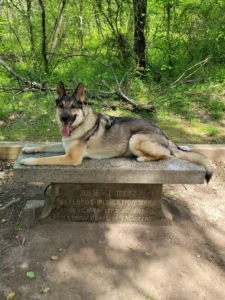
This part of the article is especially close to my heart.
Kiara is my 12-year-old German Shepherd, and she was diagnosed with hip dysplasia when she was just nine months old.
Her hips are severely affected.
When I first learned how bad they were, I never imagined she would still be doing as well as she is today.
In fact, if I’m being completely honest, I never expected her to reach 12 years old.
I thought her hips would eventually slow her down so much, or cause so much pain, that I would have to face a decision no dog owner ever wants to make.
But here she is.
And every day I get with her is a blessing. 💜
🐾 I Never Wanted Hip Dysplasia to Take Away Everything She Loved
Kiara has always loved to run and play.
One of her favorite games has always been fetch.
I didn’t stop her from doing everything she enjoyed simply because her X-rays showed severe hip dysplasia.
Instead, I made adjustments.
If she wanted to play fetch, I let her play, but I kept the sessions shorter than I might have with a dog without hip problems.
I didn’t count every throw or follow a strict formula.
I simply watched her, limited the amount of repetitive activity, and tried to find a reasonable balance.
My goal has always been to give Kiara the best life I possibly can, for however long that may be.
🥣 Keeping Kiara Slim Has Always Been Important
One thing I’ve been consistent about throughout Kiara’s life is her weight.
I’ve always kept her slim, but not thin.
I never wanted her carrying unnecessary weight on joints that were already compromised.
When she was younger, we went on regular walks, and she continued to enjoy playing and spending time with us.
I adjusted her activity when needed, but I didn’t completely take away the things she loved.
🩺 Kiara's Long-Term Care and Pain Management
Kiara has taken Phycox, a joint supplement, for most of her life.
She has also received regular veterinary checkups.
Now that she’s older, her care includes prescription pain medication and Librela injections as directed by her veterinarian.
One of her medications requires blood work every six months so her veterinarian can monitor her health.
I want to be clear that Kiara’s supplement and medication routine is specific to her. It isn’t a treatment plan that every German Shepherd with hip dysplasia should follow.
The evidence for joint supplements varies, and prescription medications can have risks and side effects. Pain treatment should always be selected and monitored by a veterinarian.
We haven’t needed to make major changes around the house, and she hasn’t participated in formal physical therapy.
We’ve simply continued to monitor her, work with her veterinarian, and adjust her care as she’s gotten older.
🎥 Watch Kiara Playing Frisbee
This little video shows Kiara playing Frisbee inside my former dog training facility.
It was recorded on April 29, 2018, years after she was diagnosed with severe hip dysplasia.
I love having this video because it shows a part of Kiara’s personality that has always meant so much to me.
She loves having fun!
I share it because I want people to understand that a hip dysplasia diagnosis doesn’t always mean a dog will immediately lose the ability to enjoy life.
At the same time, I wouldn’t recommend Frisbee or other jumping and twisting activities for every dog with hip dysplasia. These activities can put stress on affected joints, and what’s appropriate for one dog may not be safe for another.
Kiara’s activity has always been something I’ve tried to balance with her individual comfort and needs.
🐾 Kiara's Recent CCL Injury
Within the past six months, Kiara also suffered a cranial cruciate ligament injury, commonly called a CCL injury.
That’s a knee ligament injury, not the same thing as hip dysplasia.
We followed a prolonged period of restricted activity as part of her recovery plan.
After approximately six months, she’s back to enjoying her usual daily activities.
Her recovery is another reminder to me that older dogs can face more than one orthopedic challenge, and that each injury deserves its own veterinary evaluation and care plan.
💜 What Kiara Has Taught Me About Quality of Life
If there’s one thing I want people to take away from Kiara’s story, it’s this:
Don’t judge your dog’s entire life by what an X-ray shows.
X-rays are important. They help veterinarians understand what is happening inside a dog’s joints.
But they aren’t the only way to evaluate quality of life.
We also need to consider pain, comfort, mobility, appetite, behavior, enjoyment, and the ability to participate in daily activities.
Kiara has severe hip dysplasia, yet most people who meet her don’t even realize she has it.
That doesn’t mean she’s never experienced pain. She has, and her current pain management is an important part of keeping her comfortable.
But it does mean her diagnosis hasn’t defined every part of her life.
I never expected to have 12 years with her.
Now, every extra day feels like a gift.
And I’m grateful for every one of them. 💜🐾
🩺 Can German Shepherd Hip Dysplasia Be Treated?
Yes. There are several ways veterinarians can help dogs with hip dysplasia.
Treatment depends on the dog’s age, symptoms, joint changes, overall health, and quality of life.
Not every dog needs surgery, but some dogs benefit greatly from it.
🥣 Weight Management
Keeping a dog at a healthy, lean body weight is one of the most important parts of managing hip dysplasia.
Extra weight increases the load on painful joints.
Even modest weight reduction can help an overweight dog move more comfortably.
🐾 Appropriate Exercise and Rehabilitation
Regular, controlled movement can help maintain muscle strength and mobility.
Depending on the dog, a veterinarian may recommend shorter walks, changes in activity, physical rehabilitation, or exercises designed to support the joints.
Swimming or underwater treadmill therapy may be helpful for some dogs when supervised appropriately.
High-impact activities may need to be reduced or avoided.
💊 Pain Management
Veterinarians may prescribe medications to help manage arthritis pain and inflammation.
Some dogs also receive other treatments for osteoarthritis, depending on their individual needs.
These medications require veterinary oversight, and some need regular blood testing or other monitoring.
Never give your German Shepherd human pain medication unless your veterinarian specifically instructs you to do so.
🦴 Surgical Options
For some dogs, surgery may be recommended.
Depending on the dog’s age and condition, procedures can include:
*Juvenile pubic symphysiodesis for carefully selected very young puppies
*Double or triple pelvic osteotomy for certain young dogs
*Femoral head and neck ostectomy
*Total hip replacement
Each procedure has different requirements, benefits, limitations, and recovery needs.
A veterinarian or veterinary orthopedic surgeon can explain whether surgery is appropriate for a particular dog.
You can learn more about these options from the American College of Veterinary Surgeons.
🧬 How I Approach Hip Health at Purple Pups GSD
As a German Shepherd breeder, hip health is something I take seriously.
My experience with Kiara has made me especially aware of how important joint health can be throughout a dog’s life.
That’s why hip evaluations are part of my breeding program.
🩺 Why I Use PennHIP Evaluations
My breeding females receive PennHIP evaluations to help me understand their hip laxity and make informed breeding decisions.
PennHIP provides measurements that help me evaluate each dog’s hips rather than relying only on whether a dog appears to move normally.
Both of my current breeding females have remained free of noticeable hip problems.
However, I know that a dog appearing healthy doesn’t automatically mean its hips are ideal.
That’s why objective testing matters.
🧬 How I Choose Stud Dogs
When choosing a stud dog, I look at hip health as part of the bigger picture.
I prefer studs with lower hip laxity measurements to complement my females.
My goal is to make thoughtful breeding choices that may help improve hip health in future generations.
Of course, a stud’s hip results aren’t the only consideration. Responsible breeding also involves evaluating other health information, temperament, and overall suitability.
I don’t believe in promising that every puppy will have perfect hips.
No responsible breeder can guarantee that.
What I can do is use the information available to me, make careful decisions, and keep learning.
💜 Breeding and Puppy Raising Work Together
I believe responsible breeding is only the beginning.
Once a puppy goes home, its new family has an important role in supporting healthy growth.
That’s why I encourage families to pay attention to appropriate exercise, body weight, nutrition, and regular veterinary care.
I want my puppy families to understand not only what I do before their puppy is born, but also what they can do to help support their puppy’s long-term health.
You can learn more about my approach on my Breeding Philosophy page.
🛡️ Understanding My Lifetime Genetic Health Guarantee
At Purple Pups GSD, I provide a Lifetime Genetic Health Guarantee as part of my puppy purchase agreement.
I believe families deserve clear information about what a health guarantee does and does not cover.
Because hip dysplasia has both hereditary and environmental influences, a diagnosis alone does not automatically qualify for coverage.
Severe hip dysplasia may qualify when veterinary evidence supports a significant hereditary component and the requirements of the signed agreement are met.
Claims may require veterinary records, diagnostic imaging, or additional veterinary opinions.
My guarantee is not a promise that every orthopedic problem or treatment expense will be covered.
The signed purchase agreement contains the official terms, conditions, exclusions, and available remedies.
I encourage every prospective puppy family to read my Lifetime Genetic Health Guarantee before bringing home a puppy.
I believe transparency helps families make informed decisions.
❓ German Shepherd Hip Dysplasia Frequently Asked Questions
At what age can German Shepherds develop hip dysplasia?
Hip dysplasia develops as a dog’s hip joints grow, and symptoms can appear during puppyhood or later in life.
Some puppies show signs within their first year, while other dogs don’t develop noticeable problems until adulthood.
Kiara was diagnosed when she was just nine months old.
❓❓❓
Can a German Shepherd have hip dysplasia without limping?
Yes. Some German Shepherds have hip dysplasia without obvious limping or difficulty walking.
Dogs may compensate for joint discomfort, and symptoms don’t always match the severity of changes seen on X-rays.
A veterinary examination is the best way to investigate concerns about hip health.
❓❓❓
Can too much exercise cause hip dysplasia?
Hip dysplasia has a strong genetic component, but environmental factors can influence joint development and disease severity.
Excessive or inappropriate exercise may add stress to growing joints, especially in dogs already at risk.
That doesn’t mean ordinary puppy play causes hip dysplasia.
I recommend avoiding prolonged forced running and unnecessary repetitive high-impact activity while allowing appropriate daily movement.
❓❓❓
Can German Shepherd puppies climb stairs?
Yes, puppies can generally learn to use stairs carefully, but they should be supervised.
I recommend avoiding repeated, unnecessary stair sessions, particularly with very young puppies, and taking precautions on slippery surfaces.
There isn’t a single stair limit that applies to every puppy.
❓❓❓
Should I take my German Shepherd puppy jogging?
I don’t recommend structured long-distance jogging with a growing German Shepherd puppy.
Instead, I encourage age-appropriate walks, supervised play, and gradual conditioning as the dog matures.
Before starting a regular jogging program, discuss your dog’s physical maturity and joint health with your veterinarian.
❓❓❓
Can a German Shepherd with severe hip dysplasia live a long life?
Yes, some dogs with severe hip dysplasia live long and fulfilling lives.
Kiara is now 12 years old despite being diagnosed with severe hip dysplasia at nine months.
However, every dog is different.
Pain control, mobility, other medical conditions, and overall quality of life should guide care decisions.
❓❓❓
Does PennHIP testing guarantee puppies without hip dysplasia?
No.
PennHIP testing provides valuable information about hip laxity and can help breeders make informed decisions.
But hip dysplasia is influenced by multiple genes and environmental factors.
Even carefully selected breeding pairs can produce puppies that develop hip problems.
❓❓❓
Can hip dysplasia be cured?
Hip dysplasia is a developmental problem, so medications and exercise changes do not correct the underlying joint structure.
However, many dogs can be managed successfully with veterinary care, and certain surgeries can significantly improve joint function and comfort.
Treatment options depend on the individual dog.
❓❓❓
Is hip dysplasia always inherited?
Genetics is a major factor in hip dysplasia, but it is not the only influence.
Growth, nutrition, body weight, and activity can affect how the condition develops or progresses.
A diagnosis alone does not establish exactly how much each factor contributed in an individual dog.
💜 My Final Thoughts: A Diagnosis Doesn't Define Your Dog
Living with Kiara has changed the way I think about hip dysplasia.
When she was diagnosed at nine months old, I worried about what her future would look like.
I worried about pain, mobility, and whether she would have the chance to enjoy a long life.
Now, at 12 years old, she continues to remind me that life doesn’t always follow the path we expect.
I don’t ignore her diagnosis.
I don’t ignore her pain.
And I certainly don’t believe every dog with severe hip dysplasia will have the same experience she has.
But I also don’t believe we should look at an X-ray and assume we already know everything about a dog’s future.
We need to look at the whole dog.
We need to work with our veterinarians, make adjustments when needed, and pay attention to comfort and quality of life.
Most importantly, we need to remember that our dogs still deserve opportunities to enjoy the things that make them happy, within the limits of what is safe and comfortable for them.
Kiara has given me more wonderful years than I ever expected.
And I will always be grateful for that.
Every day with her is a blessing. 💜🐾
🐾 Have Questions About German Shepherd Health?
I’m Samone Puffenbarger, the breeder behind Purple Pups GSD in Woodbridge, Virginia.
I believe that choosing a German Shepherd should begin with learning about the breed, including its health needs, personality, and lifelong care.
My goal is to raise German Shepherd puppies thoughtfully and help families understand the responsibilities that come with bringing one home.
If you’d like to learn more about my breeding program, you’re welcome to explore my website.
🐾 Explore Available German Shepherd Puppies
🩺 Read My Lifetime Genetic Health Guarantee
I always encourage families to ask questions, do their research, and choose a breeder who values honesty and the long-term well-being of their dogs.
With love for German Shepherds,
Samone Puffenbarger
Purple Pups GSD
Woodbridge, Virginia 💜
Educational note: This article shares my personal experience as a German Shepherd owner and breeder, along with general veterinary information. It is not a substitute for veterinary diagnosis or treatment. Always work with your veterinarian to make decisions about your dog’s health.
Want More Information?
Hobo Masked, Isabella, and more – our pups are as unique in personality as they are in color.